




2014年英è¯å››çº§è€ƒè¯•æ¯�日一练(3月21æ—¥)
- 第1é¡µï¼šç»ƒä¹ è¯•é¢˜
1ã€�回ç”题
Language is, and should be, a living thing, constantly enrichedwith new words and forms of expression. But there is a vital distinctionbetween good developments, which add to the language, enabling us to say thingswe could not say before, and bad developments, which subtract from the languageby rendering it less precise. A vivacious, colorful use of words is not to beconfused with mere slovenliness. The kind of slovenliness in which someprofessionals deliberately indulge is perhaps akin to the cult(è¿·ä¿¡)of the unfinished work, whichhas eroded most of the arts in our time. And the true answer to it is the samethat art is enhanced, not hindered, by discipline. You cannot carvesatisfactorily in butter.
The corruption of written English has been accompanied by an evensharper decline in the standard of spoken English. We speak very much less wellthan was common among educated Englishmen a generation or two ago.
The modern theatre has played a baneful (有害的)part in dimming ourappreciation of language. Instead of the immensely articulate dialogue of, forexample, Shaw (who was also very insistent on good pronunciation), audiencesare now subjected to streams of barely literate trivia, often designed, onlytoo well, to exhibit 'lack of communication', and larded(夹�)with the obscenities(下�的�)and grammaticalerrors of the intellectually impoverished. Emily Post once advised her readers:"The theatre is the best possible place to hear correctly-enunciatedspeech. " Alas, no more. One young actress was recently reported to betaking lessons in how to speak
badly, so that she should fit in better.
But the BBC is the worst traitor. After years of very successfullyhelping to raise the general standard of spoken English, it suddenly went intoreverse. As the head of the Pronunciation Unit coyly(�蓄地)put it, "In the 1960s theBBC opened the field to a much wider range of speakers." To hear a BBCdisc jockey talking to the latest ape-like pop idol is a truly shockingexperience of verbal squalor. And the prospect seems to be of even worse tocome. School teachers are actively encouraged to ignore little Johnny'sincoherent grammar, atrocious spelling and haphazard punctuation, becauseworrying about such things might inhibit his creative genius.
The writer relates linguistic slovenliness to tendencies inthe arts today in that they both __________.
A.occasionally aim at a certain fluidity
B.appear to shun perfection
C.from time to time show regard for the finishing touch
D.make use of economical short cuts
2�Which of the following statements is NOT true?
A.The results of economic decisions can not always be predicte
B.Minimum wage can not always protect employee
C.Economic theory can predict the results of economic decisions if other factors are not changin
D.Economic decisions should not be based on economic theor
3�
Questions are based on the conversation you have just heard. æ ¹æ�®æ‰€å�¬å†…容å�Šæ��问,作ç”____
A. Because she thinks there's no way anyone else could fit o
B. Because she thinks that 20 minutes late for a train is pretty standar
C. Because she finds that it's hard to find the commutin
D. Because she was shocked by the complicated schedule
填空题
4� I’m not sure whethel"1 want to take this course;___________________(我周����)to see if I like it?
5�Kids who often struggle over words and_______ (�解课文有困难)find little enjoymentin the process of reading.
6�

7ã€�æ ¹æ�®ä»¥ä¸‹èµ„料,回ç”题。
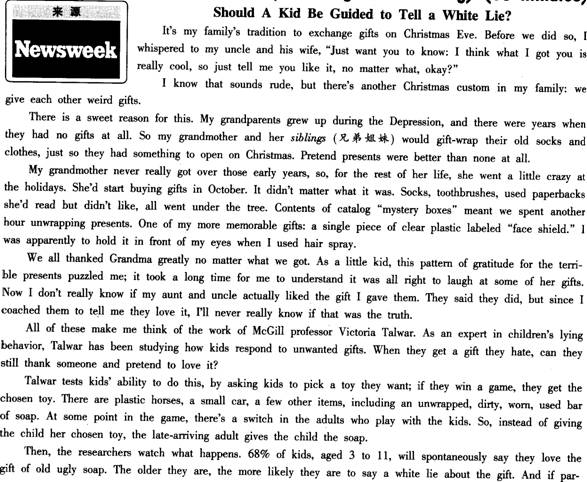

How did the author's grandmother and her siblings manage to receive Christmas gifts during the Depression?
A) They earned money to buy gifts for each other.
B) They made pretend presents with old things.
C) They started buying gifts in October.
D) They gave each other weird gifts.
简ç”题
8ã€�åŒ—äº¬æœ‰æ— æ•°çš„èƒ¡[å�¸(hutong)。平民百姓在胡å�Œé‡Œçš„生活给å�¤éƒ½åŒ—京带æ�¥äº†æ— ç©·çš„é…力。北京的胡å�Œä¸�仅仅是平民百姓的生活环境,而且还是一门建ç‘艺术。通常,胡å�Œå†…有一个大æ�‚院,房间够4到l0个家åºçš„å·®ä¸�多20å�£äººä½�。所以,胡å�Œé‡Œçš„生活充满了å�‹å–„和人情味。如今,éš�ç�€ç¤¾ä¼šå’Œç»�济的飞速å�‘展,很多胡å�Œè¢«æ–°çš„高楼大厦所å�–代。但愿胡å�Œå�¯ä»¥ä¿�留下æ�¥ã€‚
9ã€�  公元220年开始的300年里,ä¸å›½åˆ†æˆ�了三个å°�王国。一个是é�国,ä½�于ä¸å›½åŒ—部,由曹æ°�家æ—�(the Ts’ao family)统治。还有一个王国å�«ä½œèœ€æ±‰(Shu Han),ä½�于ä¸å›½çš„西å�—部,由刘备统治。å�¦å¤–一个王国å�«ä½œå�´å›½ï¼Œä½�于ä¸å›½çš„东å�—部,由å™æ�ƒ(Sun Ch·ua)统治。ä¸å›½æ–‡åŒ–里伟大的书ç±�之——《三国演义》(the Romance ofthe Three Kingdoms)就是关于这段时间的。
10ã€�Soon after he transferred to the new school.Ali found that he had________________ (很难跟上ç�里的å�Œå¦) in math and English.
| ¿Î³ÌרҵÃû³Æ | ½²Ê¦ | Ô¼Û/ÓÅ»Ý¼Û | Ãâ·ÑÌåÑé | ±¨Ãû |
|---|---|---|---|---|
| ¡¶´óѧӢÓïËļ¶¡·¾«Æ·°à£¨°üÀ¨Óï·¨¡¢´Ê»ã¡¢·Ò룩 | ¶¡Ñ©Ã÷ | £¤100 / £¤100 |  |
±¨Ãû |
| ¡¶´óѧӢÓïËļ¶¡·¾«Æ·°à£¨ÔĶÁÀí½â£© | ¶¡Ñ©Ã÷ | £¤100 / £¤100 | |
±¨Ãû |
| ¡¶´óѧӢÓïËļ¶¡·¾«Æ·°à£¨ÌýÁ¦£© | ¶¡Ñ©Ã÷ | £¤100 / £¤100 | |
±¨Ãû |
| ¡¶´óѧӢÓïËļ¶¡·¾«Æ·°à£¨Ð´×÷£© | ¶¡Ñ©Ã÷ | £¤100 / £¤100 | |
±¨Ãû |


